
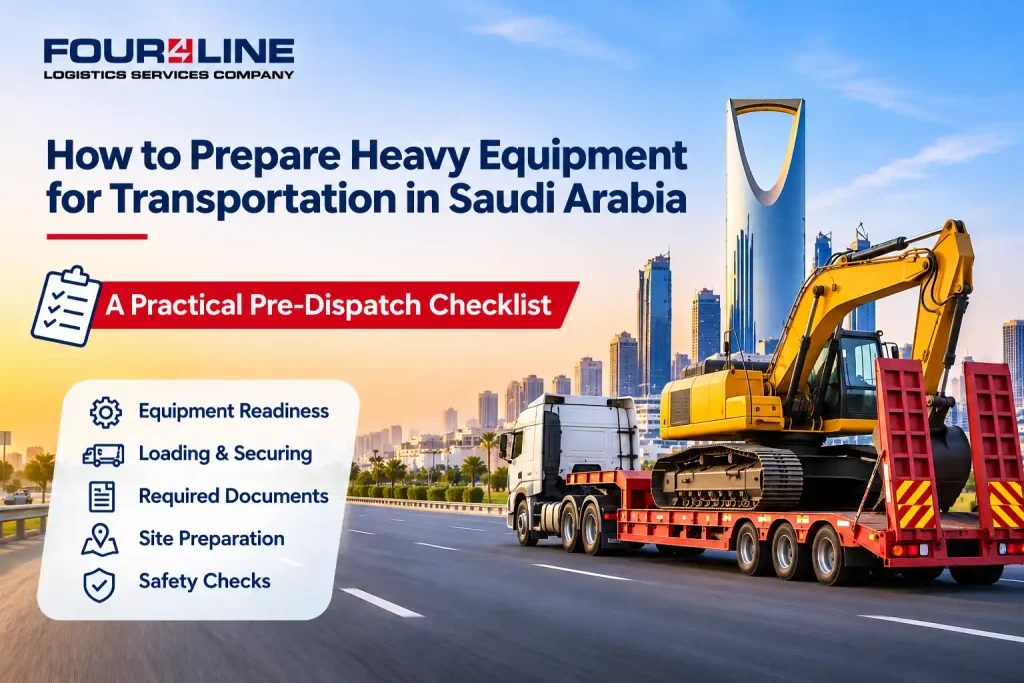
How to Prepare Heavy Equipment for Transportation in Saudi Arabia: A Practical Pre-Dispatch Checklist
Imagine booking a low-bed trailer to move an excavator from Dammam to Riyadh. The truck arrives on schedule, but the excavator won’t start. The operator who knows the machine is unavailable, and nobody has arranged alternative loading equipment.
The trailer is ready. The paperwork may be ready. The machinery isn’t.
This is the kind of avoidable situation that can turn a straightforward equipment movement into an expensive day of waiting.
Preparing heavy equipment for transportation means checking the machinery, confirming its weight and dimensions, organising loading and unloading, preparing documents and making sure both locations can accommodate the transport vehicle.
Whether you’re relocating an excavator, bulldozer, wheel loader or industrial generator, the basic preparation principles remain similar.
This guide provides a practical heavy equipment transport checklist for businesses moving machinery within Saudi Arabia. It explains what to inspect, what information to share with the transporter and what to confirm before dispatch.
What Should You Check Before Transporting Heavy Equipment?
Before transporting heavy equipment, check the machine’s actual specifications, mechanical condition, attachments, loading requirements and collection and delivery arrangements.
These five areas determine whether the movement can proceed according to plan.
Start with the machine itself.
Construction equipment often carries attachments or accessories that aren’t obvious from the model description. An excavator may have a hydraulic breaker, additional bucket or other equipment that needs separate handling.
The transport provider must know what is actually being moved.
The next step is confirming whether the machine can operate safely.
A working excavator may be suitable for loading using an approved ramp arrangement. A machine with a failed hydraulic system may need specialist recovery or lifting equipment.
Then consider the site.
A trailer might be suitable for the machinery but unable to enter the collection area because of restricted access, unsuitable ground or insufficient turning space.
Finally, contact the receiving location.
The delivery team must be prepared to accept and unload the equipment.
A simple pre-dispatch review should answer three basic questions:
- Is the machine ready to move?
- Are the transport and loading arrangements suitable?
- Is the destination ready to receive it?
Confirm all three before finalising the collection.
How Do You Prepare an Excavator for Transportation?
An excavator should be inspected, placed in its approved transport configuration and prepared for the loading method specified in the transport plan.
The manufacturer’s operator manual is the starting point. Different excavator models can have different transport and securing instructions.
Inspect the Mechanical Condition
Check the tracks, hydraulic hoses, visible fittings and attachments.
Look for loose parts, fluid leaks or damage that could interfere with loading.
Confirm whether the excavator can move safely under its own power.
If it cannot, inform the transport provider before the truck arrives.
Check the Boom, Arm and Bucket
The excavator’s boom, arm and bucket must be positioned according to its approved transport instructions.
This arrangement affects the machine’s overall height and the space required on the trailer.
Do not assume that the position used for one excavator is suitable for another model.
Account for Additional Attachments
Confirm whether the bucket, hydraulic hammer, ripper or other accessories will remain fitted or travel separately.
Separate items need appropriate handling and securing arrangements.
They also need to be included in the shipment information.
Remove Loose Debris
Construction machinery can accumulate soil, rocks and other material.
Remove loose debris that could fall during loading or transportation.
Identify the Correct Securing Points
Locate the manufacturer’s designated tie-down points.
The qualified transport team must select suitable securing equipment and confirm the final restraint arrangement before departure.
An excavator’s preparation should never be reduced to simply driving it onto a trailer and attaching a few chains.
For readers who need more information about trailer selection, this guide to low bed transportation for heavy equipment explains how different machinery requirements affect the transport arrangement.
What Equipment Measurements Are Needed Before Booking Transportation?
The transporter needs the machine’s actual transport weight, length, width and height, including any attachments that will remain fitted during the journey.
These measurements help establish trailer suitability, total loaded dimensions and route requirements.
A machine’s standard catalogue specifications may not describe its current configuration accurately.
For example, a wheel loader may have an attachment that changes its overall length.
An excavator’s boom position can affect its transport height.
Industrial machinery may contain additional components that change its total shipping weight.
Equipment Measurement Checklist
| Required information | What to confirm |
|---|---|
| Manufacturer and model | Exact machine identification |
| Transport weight | Actual weight in the planned configuration |
| Overall length | Includes fitted attachments |
| Overall width | Widest point in transport configuration |
| Overall height | Height in the approved transport position |
| Attachments | Fitted and separately transported components |
| Lifting points | Manufacturer-approved lifting arrangements |
| Securing points | Approved tie-down locations |
| Operating condition | Whether the machine can self-load |
Why Accurate Measurements Matter
Incorrect information can affect the selected trailer.
It may also affect whether the route is suitable.
A machine that is wider or taller than initially declared may require a revised transport plan.
For unusual or oversized cargo, the transporter may need additional technical drawings and load-distribution information.
Where the shipment exceeds applicable vehicle or load limits, special movement requirements may apply.
Detailed guidance on these considerations is covered in the article about transporting oversized equipment in Saudi Arabia.
Practical tip: Send the equipment specification sheet together with recent photographs. If attachments have been modified or replaced, mention those changes clearly.
How Should Heavy Machinery Be Prepared for Safe Loading?
Safe loading begins with selecting a suitable handling method and preparing a stable, controlled working area.
The loading procedure should be appropriate for both the machine and the trailer.
Loading Machinery That Can Operate
Some excavators, bulldozers and wheel loaders may be loaded under their own power.
This requires a suitable trailer, approved loading arrangements and a trained operator.
Before loading, the responsible team should confirm the ground conditions, trailer position and equipment instructions.
People who are not involved in the loading operation should remain outside the work area.
The operator must follow the agreed loading procedure and stop if conditions become unsafe.
Loading Non-Operational Equipment
A machine that cannot operate safely may need a different approach.
The handling team might need a suitable winching, recovery or lifting arrangement.
The correct method depends on the equipment’s weight, condition, approved lifting points and site circumstances.
Specialist lifting must be planned and supervised by qualified personnel.
A construction-site crane should never be assumed suitable simply because it is available nearby.
Preparing the Loading Area
The loading site should provide:
- Stable ground suitable for the equipment and trailer
- Sufficient space for vehicle positioning
- Clear access for machinery and authorised personnel
- Suitable loading or lifting equipment
- A defined work area away from unrelated site traffic
- Clear communication between the responsible operators
These checks are especially important at busy construction sites where several contractors may be working at the same time.
Arranging the loading area before collection reduces unnecessary waiting and helps the team carry out the agreed procedure safely.
What Documents Are Needed for Heavy Equipment Transportation in Saudi Arabia?
Heavy equipment transportation documents depend on the shipment type, cargo ownership, transport arrangement and applicable regulatory requirements.
A domestic machinery movement may involve fewer documents than imported industrial equipment collected from a Saudi port.
Domestic Machinery Movements
Depending on the job, relevant documents and records may include:
- Equipment identification and technical details
- Transport booking or movement instructions
- Collection and delivery information
- Applicable transport documentation
- Site-entry requirements
- Relevant insurance information
- Any required exceptional-load approvals
The specific documents should be confirmed with the transport provider and the organisations responsible for the collection and delivery.
Imported Machinery
Imported equipment can involve additional documentation.
Depending on the import arrangement, this may include commercial invoices, packing lists, bills of lading, customs declarations and cargo-release documents.
The Saudi Zakat, Tax and Customs Authority, commonly known as ZATCA, is a relevant official source for import and customs procedures.
Oversized or Overweight Equipment
Some movements require special approval because of the loaded vehicle’s weight or dimensions.
The relevant requirements must be assessed against the actual load and proposed route.
An official reference is the Saudi Exceptional Load Permit Service.
Practical tip: Keep the equipment details, site contacts, required approvals and transport instructions in one shared folder. This makes it easier for the customer, transporter and receiving team to work from the same information.
How Do You Prepare the Pickup and Delivery Locations?
Both locations should be ready for the transport vehicle before collection is confirmed.
The pickup site must accommodate loading. The delivery site must accommodate unloading.
Preparing the Collection Site
At the collection point, confirm the exact gate and map location.
Industrial facilities may have multiple entrances, and not every gate is suitable for heavy transport vehicles.
The site team should verify access restrictions, ground conditions and sufficient working space.
For example, machinery being collected from an industrial facility in Jubail may be subject to specific entry procedures.
The transport coordinator needs these details in advance.
Preparing the Delivery Site
The receiving team should know the planned unloading requirements.
If a crane or other lifting equipment is needed, it should be available as agreed.
Check the unloading area’s ground conditions and accessibility.
A machine may reach its destination without difficulty but still be unable to unload if the receiving area is not prepared.
Assign Responsible Contacts
There should be a named contact at each location.
Both contacts should understand the planned movement and their responsibilities.
Provide their telephone numbers to the transport coordinator.
This avoids unnecessary confusion when site conditions change or the vehicle reaches the collection gate.
What Are the Most Common Mistakes Before Heavy Equipment Dispatch?
The most common pre-dispatch mistakes involve incomplete machine details, incorrect loading assumptions, unprepared sites and unclear responsibilities.
Most are preventable.
1. Giving an Estimated Machine Weight
A general description such as a 20-tonne excavator may not reflect the machine’s actual transport weight.
Attachments and equipment modifications can change the final figure.
Provide verified specifications rather than relying on an approximate description.
2. Forgetting About Attachments
Buckets, breakers and other accessories may need to be transported separately.
Leaving them out of the original booking can complicate the loading and securing plan.
3. Assuming the Machine Can Self-Load
A machine may have been operational recently but no longer be safe to move.
Confirm its current condition before the transport vehicle is dispatched.
4. Ignoring Ground Conditions
Soft or unstable ground can affect trailer positioning and machinery loading.
The responsible site team should assess whether the collection area is suitable.
5. Forgetting the Unloading Arrangement
A scheduled delivery does not mean the receiving site is ready.
Confirm who will unload the machine and what equipment they will use.
6. Providing an Incomplete Address
A general location such as Dammam Industrial Area is not enough for every shipment.
Provide the correct gate, map pin and receiving contact.
7. Leaving Approvals Until Collection Day
Missing site-entry documents or applicable transport permissions can delay dispatch.
Confirm these requirements before the scheduled movement.
8. Failing to Agree on Responsibilities
The customer may expect the transporter to arrange lifting.
The transporter may have quoted only for road transportation.
Confirm the agreed service scope in writing before dispatch.
How Do You Inspect Heavy Equipment Before Dispatch?
A pre-dispatch inspection should record the machine’s condition and confirm that the agreed loading and transport preparation steps have been completed.
It should take place before loading and be followed by an appropriate final inspection once the machine is secured.
Equipment Condition Inspection
Check the machine for visible damage and leaks.
Confirm that loose parts and attachments have been addressed.
Review the condition of tracks, tyres or other components relevant to the loading method.
Record any existing damage before the equipment is transported.
Loading Readiness Inspection
Confirm the appropriate trailer and handling arrangements.
Check that the loading area is suitable.
Make sure the responsible personnel understand the agreed procedure.
Final Transport Inspection
After loading, the qualified transport personnel should verify the machine’s position and securing arrangements.
The final loaded dimensions should match the transport plan.
Any applicable documentation or approval conditions should also be checked.
Photographs taken before collection and after loading can provide a useful record.
The inspection should identify the machine, date, location and responsible personnel.
This process does not replace statutory inspections, specialist lifting procedures or the manufacturer’s instructions.
What Should Be Included in a Heavy Equipment Transport Checklist?
A useful heavy equipment transport checklist should cover the machine, loading method, route requirements, documentation and delivery arrangements.
The following 15-point checklist can be used before dispatch.
15-Point Heavy Equipment Pre-Dispatch Checklist
-
1. Confirm the equipment manufacturer and model.
-
2. Verify the actual transport weight.
-
3. Record the transport length, width and height.
-
4. Identify all fitted and separate attachments.
-
5. Confirm the machine’s operating condition.
-
6. Inspect for visible leaks, damage and loose components.
-
7. Review the manufacturer’s transport preparation instructions.
-
8. Confirm the approved loading method.
-
9. Provide photographs and relevant technical drawings.
-
10. Confirm that the selected trailer is suitable.
-
11. Check collection-site access and ground conditions.
-
12. Confirm destination access and unloading arrangements.
-
13. Check applicable documents, site approvals and permits.
-
14. Share the agreed collection date and responsible contacts.
-
15. Complete the final loading and securing inspection before departure.
This checklist is intended for planning and coordination. It should be used alongside the applicable operating manuals, transport procedures and safety requirements.
How Can Better Preparation Reduce Transport Delays and Costs?
Good preparation can reduce avoidable delays by helping the transport provider arrange suitable equipment and identifying handling problems before collection.
Consider a machinery movement from an equipment supplier in Dammam to a construction site in Riyadh.
If the supplier provides correct dimensions, confirms the machine’s operating condition and prepares the loading area, the transport team can plan around those conditions.
The receiving contractor also needs to confirm site access and unloading arrangements.
Now consider the same movement with incomplete information.
The transport provider may discover that the machine cannot self-load. Additional equipment might then be required.
If the receiving site is unprepared, the trailer may have to wait after arriving.
The journey itself has not changed, but the total transport effort has increased.
What Should Procurement Teams Confirm?
Ask whether the quotation includes the agreed loading arrangements, mobilisation, permits where applicable, waiting time and unloading responsibilities.
Additional charges should be explained clearly.
For a closer look at the factors that affect pricing, refer to our low-bed transportation cost guide.
The most useful way to manage transport costs is to eliminate assumptions before the movement starts.
Frequently Asked Questions About Heavy Equipment Transport Preparation
What should I check before moving an excavator?
Confirm the excavator’s model, weight, transport dimensions, mechanical condition, attachments and approved transport position. Also arrange suitable loading and unloading.
Can non-operational heavy machinery be transported?
Yes, depending on the machine and available handling methods. Specialist lifting or recovery arrangements may be needed.
What documents are needed to move heavy equipment in Saudi Arabia?
Documents depend on the shipment. Relevant information may include equipment specifications, transport instructions, applicable permits and site-access requirements.
Do all excavators need low-bed trailers?
No single trailer type is suitable for every excavator. Selection depends on weight, dimensions, loading arrangements and applicable transport requirements.
Why do equipment measurements matter?
Accurate measurements help establish trailer suitability, loaded vehicle dimensions and route requirements.
Can attachments travel with the machine?
Attachments may travel fitted or separately if the arrangement is suitable and follows the equipment manufacturer’s instructions and applicable securing requirements.
Who should arrange loading and unloading?
Responsibilities should be agreed before dispatch. Loading and lifting operations must be performed by competent personnel using appropriate procedures.
What causes delays during machinery collection?
Common causes include incorrect specifications, mechanical problems, unsuitable loading areas, missing approvals and incomplete site coordination.
How can I document equipment condition before transportation?
Record the machine’s identity, take clear photographs, note existing damage and retain the relevant inspection information.
How early should I prepare machinery for transportation?
Begin preparation once the movement is planned. Unusual machinery or loads requiring special arrangements may need additional coordination before the collection date.
Final Thoughts: Preparation Makes Heavy Equipment Transportation Easier
Heavy equipment transportation is not simply a matter of finding a truck that can carry the machine.
The equipment must be ready. The loading arrangement must be suitable. The route must accommodate the loaded vehicle, and the receiving site must be prepared.
For a construction supervisor, that means checking the machine before collection.
For a procurement manager, it means providing accurate specifications and confirming the service scope.
For the receiving team, it means having the correct unloading arrangements in place.
Taking care of these details early reduces uncertainty and helps everyone involved work from the same plan.
If you are preparing a machinery movement in Saudi Arabia, the 15-point checklist above is a practical starting point.
For transport-specific enquiries, Four Line Logistics can review equipment information and discuss suitable arrangements.

Abdul Shakeel is the founder of Four-Line Logistics, established in Saudi Arabia in 2023. His experience covers sea freight, customs clearance, container transportation, and GCC cross-border logistics. He has worked with Saudi customs procedures involving SABER, Fasah, Bayan declarations, and complex port clearance requirements. His focus is on practical shipping solutions, accurate documentation, and helping businesses manage cargo movement more effectively.