3PL vs Freight Forwarder: Which Logistics Service Does Your Business Need in Saudi Arabia?
Your business imports products from China. The goods arrive at a Saudi port, clear customs and travel to a warehouse in Riyadh.
So far, everything is going according to plan.
Then the next set of questions comes up. Someone needs to receive the inventory, store it, keep track of stock levels and deliver orders to different customers.
The company that arranged your international shipment may not be the company best suited to handle those daily warehouse operations.
This is where the difference between a freight forwarder and a third-party logistics provider becomes important.
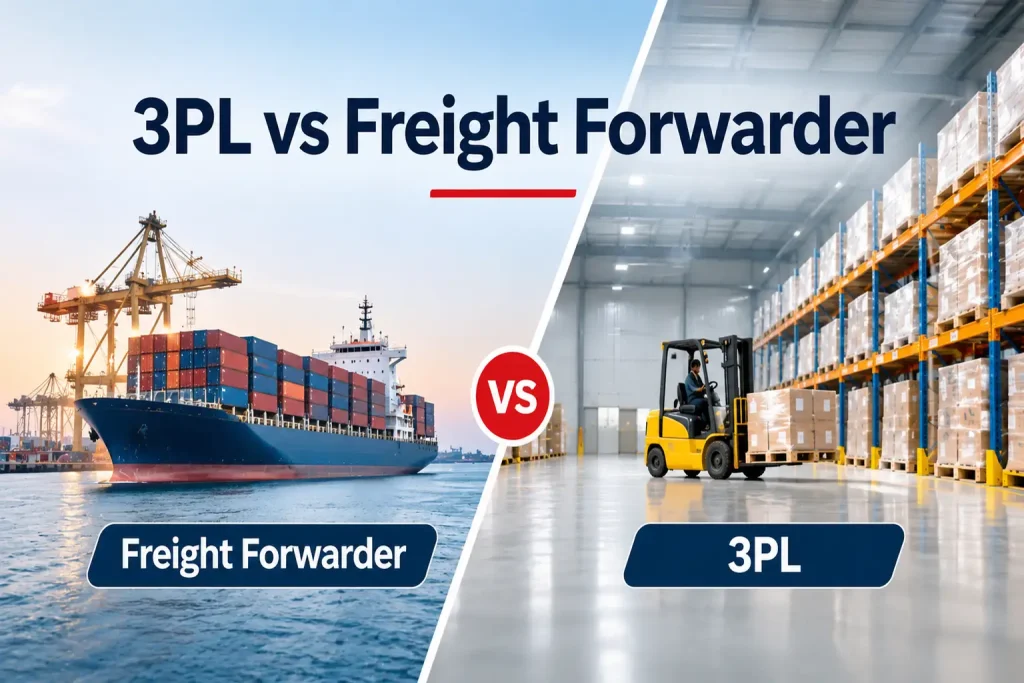
A freight forwarder primarily coordinates the movement of goods, especially across international borders. A third-party logistics provider (3PL) manages outsourced logistics activities, which may include warehousing, inventory management, order fulfilment and transportation.
Some companies offer both services. Others specialise in just one.
For Saudi importers, manufacturers, distributors and growing businesses, understanding this distinction can help prevent operational gaps and unnecessary logistics expenses.
What Is the Difference Between a 3PL and a Freight Forwarder?
The main difference between a 3PL and a freight forwarder is the scope of responsibility.
A freight forwarder focuses on getting cargo from its origin to the agreed destination. A 3PL can take responsibility for ongoing logistics operations, such as storing inventory and preparing customer orders.
Consider a business importing electrical equipment through King Abdulaziz Port in Dammam.
The freight forwarder may arrange shipping from the overseas supplier, coordinate transport documents and organise onward delivery.
Once the equipment reaches a warehouse, a 3PL provider may receive the stock, update inventory records, manage storage locations and arrange deliveries to customers.
The two businesses serve different stages of the same supply chain.
3PL vs Freight Forwarder: Quick Comparison
| Factor | Freight forwarder | 3PL provider |
| Main responsibility | Cargo movement and shipping coordination | Outsourced logistics operations |
| International shipping | Core service for many providers | May be included |
| Warehousing | Sometimes arranged | Common service |
| Inventory management | Usually not the main function | Often a core function |
| Order fulfilment | Usually limited or outsourced | Common for fulfilment-focused 3PLs |
| Customs coordination | Common in international forwarding | Depends on provider |
| Domestic distribution | Can be arranged | Commonly included |
| Best suited for | Importers and exporters moving shipments | Businesses outsourcing recurring logistics activities |
These are common service patterns, not strict industry boundaries.
A freight forwarder may offer warehousing. A 3PL may coordinate international shipments.
The right question is what the provider actually agrees to manage.
What Does a Third-Party Logistics Company Do?
A third-party logistics company manages logistics activities on behalf of another business.
The services depend on the provider’s business model.
Some 3PL companies specialise in ecommerce fulfilment. Others focus on B2B warehousing, distribution, inventory handling or transportation management.
Warehousing
A 3PL may receive goods from suppliers and store them in a managed facility.
For example, an electronics distributor may import several shipments each month but prefer not to operate its own warehouse.
A suitable 3PL can handle the agreed receiving and storage activities.
Inventory Management
Many warehouse-based 3PL providers track stock movements through a warehouse management system.
This helps businesses monitor quantities, storage locations and outgoing orders.
Inventory visibility becomes particularly important when several customers or sales channels share the same stock.
Order Fulfilment
A fulfilment-focused 3PL may pick products from storage, pack orders and prepare them for dispatch.
This service is useful for ecommerce brands, spare-parts suppliers and businesses shipping frequent smaller orders.
Distribution
Some 3PL providers also arrange deliveries to shops, distributors, factories or individual customers.
The service may involve contracted transport companies or an established distribution network.
Returns and Additional Handling
Certain providers manage returned goods, relabelling, repacking or other agreed activities.
These services should be confirmed individually.
Not every 3PL provides temperature-controlled storage, specialised industrial handling or ecommerce fulfilment.
The important point is that 3PL describes an outsourcing model, not one standard package of services.
What Does a Freight Forwarder Do?
A freight forwarder arranges and coordinates cargo transportation between the shipper and the destination.
The work often involves several organisations, including carriers, shipping agents, terminals, customs-related service providers and road transport companies.
Imagine a Saudi manufacturing business importing replacement production equipment from Germany.
The company needs the cargo collected, shipped to Saudi Arabia and delivered to its facility.
A freight forwarder may coordinate the international shipment, transport documentation, arrival arrangements and onward delivery.
The exact responsibilities depend on the agreed contract.
International Freight Arrangements
Freight forwarders arrange suitable shipping options according to cargo requirements.
These may include sea freight, air freight or multimodal transportation.
For regular commercial imports, the choice often depends on shipment size, urgency, handling needs and overall cost.
Shipping Documentation
A forwarder may help coordinate commercial and carrier documents required for the shipment.
The documents must accurately describe the goods and match the relevant shipping arrangements.
Customs-Related Coordination
International shipments can require customs declarations, product information and additional regulatory documentation.
A forwarder may coordinate with importers and appropriately authorised customs service providers.
Customs clearance responsibilities should be confirmed rather than assumed.
Inland Transportation
Many freight forwarders also arrange road transportation after cargo reaches a port or airport.
For example, imported machinery arriving in Dammam may need suitable transportation to an industrial facility in Riyadh.
Businesses interested in this process can read more about freight forwarding services in Saudi Arabia.
When Should a Saudi Business Choose a Freight Forwarder?
A freight forwarder is often the better starting point when the main requirement is to move goods between suppliers, ports, airports, warehouses or project sites.
This applies to businesses that already have their own storage and distribution arrangements.
Example: Importing Industrial Equipment into Dammam
An engineering company buys a production machine from an overseas manufacturer.
Its main concerns are arranging shipping, preparing documentation and coordinating delivery to the factory.
The company does not need ongoing stock management because the machine will be installed after delivery.
A freight forwarding arrangement is likely to match this requirement better than a separate warehouse fulfilment contract.
Example: Exporting Commercial Cargo
A Saudi manufacturer needs to ship products to an overseas buyer.
The manufacturer has its own warehouse and production team.
It needs support with carrier selection, freight booking, transport documentation and shipping coordination.
A freight forwarder can help arrange the movement within the agreed service scope.
Example: Moving Cargo Between Saudi Cities
A business may already manage its inventory but need additional transport capacity between Dammam, Riyadh and Jeddah.
In that situation, domestic road freight may be enough.
It is not always necessary to outsource the wider supply chain.
The business should first identify which activities it wants an external provider to handle.
When Should a Business Choose a 3PL Logistics Provider?
A 3PL provider becomes useful when a business needs continuing support with storage, inventory handling, order preparation or distribution.
This is particularly relevant when logistics operations are taking up increasing amounts of staff time or warehouse capacity.
Example: A Growing Electronics Distributor
A distributor imports electrical products into Saudi Arabia and sells them to customers throughout the country.
Shipments arrive in larger quantities, but customer orders are dispatched in smaller batches.
The business may need a warehouse that receives stock, records inventory, prepares orders and organises deliveries.
A warehousing and distribution 3PL could be suitable.
Example: An Ecommerce Business
An online retailer receives daily orders from customers across several Saudi cities.
Its main problems are storage, picking, packing, dispatch and returns.
An ecommerce fulfilment 3PL may be more relevant than a freight forwarder focused on international shipments.
Example: A Spare-Parts Supplier
An industrial spare-parts distributor may need stock stored close to important customer locations.
It may also need inventory accuracy and planned deliveries to workshops or manufacturing facilities.
A suitable 3PL could manage these recurring activities.
The provider must have the appropriate storage and handling capabilities for the specific products.
A business should choose a 3PL because it needs outsourced operations, not simply because the company uses the term logistics in its name.
Can a Business Use Both a 3PL and a Freight Forwarder?
Yes. Many importers use a freight forwarder and a 3PL together because their responsibilities complement each other.
The freight forwarder coordinates the international movement.
The 3PL manages the agreed storage and distribution activities after the goods arrive.
Consider a Saudi company importing household appliances from China.
The shipment arrives through Jeddah Islamic Port.
The forwarder coordinates the international freight and applicable arrival-related arrangements.
After the cargo is delivered to the warehouse, the 3PL receives the products and records them in its inventory system.
As orders arrive, the warehouse team prepares the goods and arranges distribution.
How the Responsibilities Fit Together
| Supply chain stage | Typical responsible party |
| Overseas collection | Freight forwarder or origin logistics provider |
| International shipping | Freight forwarder |
| Customs-related procedures | Importer and relevant authorised parties |
| Port-to-warehouse delivery | Freight forwarder, carrier or transport provider |
| Warehouse receiving | 3PL or in-house warehouse |
| Inventory management | 3PL or business owner |
| Customer order preparation | Fulfilment 3PL or in-house team |
| Final delivery | 3PL distribution partner or carrier |
The main risk is not using two providers.
It is failing to establish where one provider’s responsibilities end and the other’s begin.
Agree on the receiving process, document handover and responsibility for damaged or missing goods before operations start.
How Much Do 3PL Services Cost Compared With Freight Forwarding?
3PL and freight forwarding costs are calculated differently because they cover different activities.
Freight forwarding prices are usually tied to shipments and transport requirements.
A 3PL agreement may involve recurring charges for storage, handling, order processing and distribution.
Common Freight Forwarding Cost Components
A freight quotation may include:
- International freight charges
- Origin handling
- Destination handling
- Documentation charges
- Applicable customs-related service charges
- Inland transportation
- Additional cargo handling where required
The actual quotation depends on the shipment and agreed service scope.
Common 3PL Cost Components
A warehouse-based 3PL quotation may include:
- Goods receiving fees
- Pallet or storage-space charges
- Inventory handling
- Picking and packing
- Packaging materials
- Order dispatch
- Returns processing
- Additional services or system integration
Some providers also charge minimum monthly fees.
Why Comparing Only the Headline Price Is Misleading
A freight forwarder may quote for delivering a shipment to a warehouse.
A 3PL may quote for receiving that same shipment and managing the goods over several months.
Those are not competing prices for the same service.
For a business evaluating both options, the useful calculation is the total logistics cost over the period being considered.
That includes transportation, storage, handling and delivery.
How Do You Compare 3PL and Freight Forwarding Quotations?
Compare logistics quotations by defining the exact work required before asking providers for prices.
A vague request for a complete logistics solution can produce offers that cover very different responsibilities.
A clearer approach is to divide the work into stages.
Step 1: Identify the Cargo
Record the product type, shipment volume, weight, dimensions and special handling requirements.
For warehouse services, also identify the number of products or stock-keeping units, commonly called SKUs.
Step 2: Understand the Shipment Pattern
Determine whether the business imports occasional shipments or receives stock regularly.
For a 3PL, estimate the expected order volume and storage duration.
Step 3: Define the Required Services
Separate international transportation, customs-related coordination, warehouse receiving, storage, picking, packing and final delivery.
Step 4: Confirm Responsibilities
Ask which provider manages each stage.
Clarify who is responsible for damaged goods, stock discrepancies and operational delays.
Step 5: Compare the Full Costs
Check mobilisation, handling fees, storage minimums, waiting charges and service exclusions.
Step 6: Review Reporting and Communication
For freight movements, ask about shipment updates and documentation.
For warehousing, ask how inventory records and order reports are shared.
A reliable comparison depends on service scope and operational suitability, not just price.
What Should Saudi Businesses Check Before Outsourcing Logistics?
Before outsourcing logistics, businesses should review the provider’s actual capabilities, facilities, operating processes and contractual responsibilities.
A company may offer international freight forwarding but have limited warehouse operations.
Another may be excellent at order fulfilment but unsuitable for moving industrial machinery.
Check Service Coverage
Confirm which activities the provider performs directly and which are coordinated through other companies.
This matters when several organisations will handle the same goods.
Review Warehouse Requirements
If storage is needed, ask about location, security, inventory processes, handling equipment and relevant product suitability.
Food, chemicals, pharmaceuticals and other regulated goods may have additional requirements.
Never assume a general warehouse is suitable for every product category.
Evaluate Industry Experience
A provider accustomed to ecommerce parcels may not be suitable for large industrial equipment.
A project cargo specialist may not operate the systems needed for thousands of small customer orders.
Choose experience that matches the actual cargo and workflow.
Agree on Service Standards
For a 3PL, this may include inventory accuracy, order-processing targets and reporting.
For a freight forwarder, it may include documentation responsibilities, shipment milestones and communication procedures.
Review Contract Terms
Understand the billing model, minimum charges, liability provisions, insurance arrangements and termination conditions.
The right provider should fit the business’s operating needs rather than simply offer the longest service list.
Why Are Logistics Outsourcing Decisions Important in Saudi Arabia?
Logistics outsourcing decisions affect how businesses connect international shipping, ports, industrial facilities, warehouses and customers throughout Saudi Arabia.
The Kingdom’s transport network supports several distinct types of cargo movement.
Dammam and Jubail serve important Eastern Province industrial and commercial requirements.
Jeddah is a major Red Sea gateway for international trade.
Riyadh is a major centre for commercial distribution and inland logistics.
The requirements of a manufacturing company in Jubail may therefore differ from those of an ecommerce business serving customers in Riyadh.
Saudi Arabia’s National Transport and Logistics Strategy also places emphasis on improving the connections between transport modes and logistics services.
For businesses, this makes coordination between international freight, domestic transportation and warehousing an important operational decision.
An importer should consider where cargo enters the country, where it needs to be stored and how frequently it must be distributed.
A company importing machinery for installation may not need the same logistics model as one importing products for daily sale.
The best outsourcing decision follows the movement of the goods and the work that must be performed at each stage.
How Do You Decide Which Logistics Service Your Business Actually Needs?
Start by identifying the main problem your business wants to solve.
If the problem is international cargo movement, start with freight forwarding.
If the problem is storing products and processing recurring orders, consider a 3PL.
If both problems exist, compare providers that can coordinate the complete arrangement or agree on a clearly defined division of responsibilities.
Quick Decision Guide
| Your business requirement | More suitable starting point |
| Import machinery from overseas | Freight forwarder |
| Export finished products | Freight forwarder |
| Arrange air or sea freight | Freight forwarder |
| Store stock for several months | Warehousing 3PL |
| Manage daily customer orders | Fulfilment 3PL |
| Track warehouse inventory | Warehouse-based 3PL |
| Distribute stock to retail branches | Distribution 3PL or transport provider |
| Import, store and distribute products | Freight forwarder + 3PL, or an integrated provider |
| Move heavy equipment between sites | Specialised road transport provider |
These are starting points, not universal rules.
The actual provider should be selected according to the services and responsibilities it can support.
Frequently Asked Questions
Is a 3PL the same as a freight forwarder?
No. A freight forwarder primarily coordinates cargo movement, especially international transportation. A 3PL manages outsourced logistics activities, which may include storage, inventory, fulfilment and distribution.
Can a freight forwarder provide warehousing?
Yes. Some freight forwarders offer or arrange warehousing, but the scope depends on the individual provider.
Do all 3PL logistics companies handle international shipping?
No. Some 3PL companies concentrate on domestic warehousing and fulfilment. Others offer international freight services.
Which is better for importing goods into Saudi Arabia?
A freight forwarder is often the better starting point for international shipping. A 3PL may also be needed when the goods require ongoing storage and distribution after arrival.
Do I need a 3PL if I already have a warehouse?
Not necessarily. A business with its own storage and fulfilment operations may only need additional transportation or freight forwarding services.
Can a 3PL manage ecommerce orders?
Yes. Fulfilment-focused 3PL providers commonly offer receiving, storage, picking, packing, dispatch and returns services.
Is 3PL more expensive than freight forwarding?
The costs cannot be compared directly without defining the service scope. Freight forwarding is usually shipment-focused, while warehouse-based 3PL arrangements may involve recurring operational charges.
Can a company use multiple logistics providers?
Yes. A business may use separate providers for international shipping, warehousing and local distribution. Clear responsibilities and communication are important.
What is the difference between 3PL and 4PL?
A 3PL performs or manages outsourced logistics activities. A fourth-party logistics provider, or 4PL, generally coordinates a wider supply-chain operation and may oversee several logistics providers.
What is the best logistics option for a manufacturing business?
The choice depends on whether the manufacturer needs international shipping, inbound material handling, warehouse management, finished-goods distribution or a combination of these services.
Final Thoughts: Choose the Service That Matches the Work
The difference between a 3PL and a freight forwarder becomes much clearer when you follow a shipment from the supplier to the final customer.
Freight forwarders primarily help arrange the journey.
3PL providers can manage the ongoing logistics activities that happen before or after transportation.
Some businesses need only one of these services. Others benefit from using both.
Before signing an agreement, define the cargo, the movement, the storage requirements and the responsibilities you want to outsource.
For Saudi businesses arranging commercial freight, import shipments or domestic cargo movements, Four Line Logistics provides information about freight forwarding and related transportation services.
The most useful logistics solution is not the one offering the greatest number of services. It is the one that can handle the work your business actually needs.

Abdul Shakeel is the founder of Four-Line Logistics, established in Saudi Arabia in 2023. His experience covers sea freight, customs clearance, container transportation, and GCC cross-border logistics. He has worked with Saudi customs procedures involving SABER, Fasah, Bayan declarations, and complex port clearance requirements. His focus is on practical shipping solutions, accurate documentation, and helping businesses manage cargo movement more effectively.