You’ve ordered five pallets of electrical components from a supplier in China. The goods are ready for shipment to Saudi Arabia, but there’s one problem: they won’t fill a shipping container.
Paying for an entire container feels unnecessary. Sending everything by air could make the freight bill difficult to justify.
This is where a freight consolidator can help.
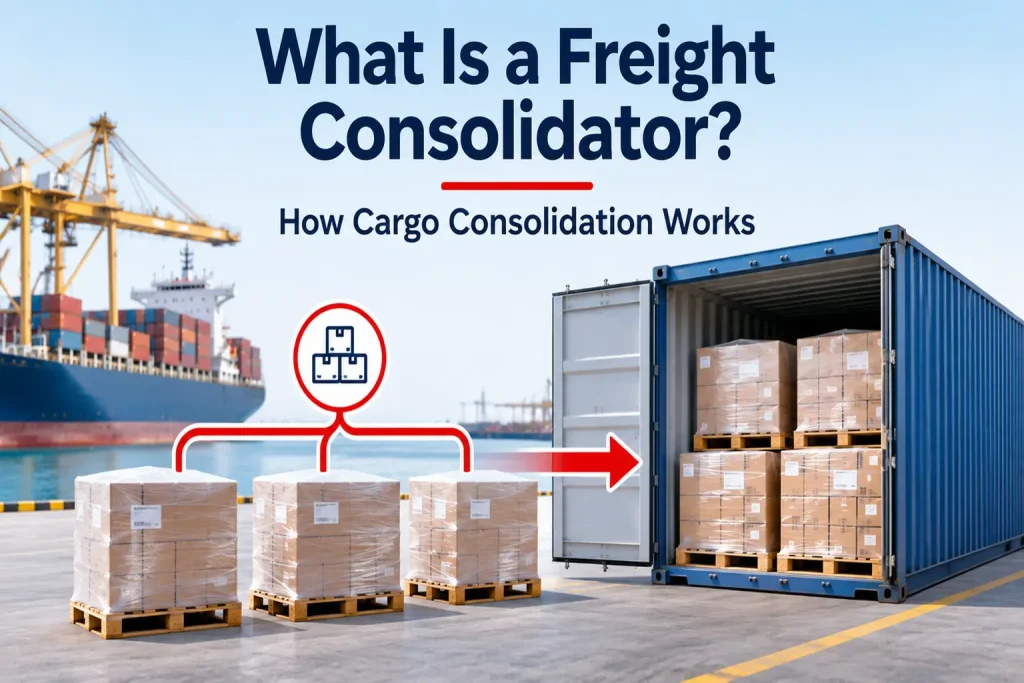
A freight consolidator combines smaller shipments from different customers into one larger shipment, allowing businesses to share transportation space and its associated costs.
In sea freight, this commonly happens through Less than Container Load (LCL) shipping. Instead of booking a full container, your cargo travels alongside other compatible consignments.
Cargo consolidation can be useful for importers ordering spare parts, commercial inventory, packaged equipment and other smaller shipments.
It isn’t automatically the cheapest option, though. Handling charges, delivery requirements and shipment timing all affect the final decision.
Here’s how freight consolidation works, what it costs and when it makes sense for businesses importing into Saudi Arabia.
What Is a Freight Consolidator?
A freight consolidator is a logistics company or specialist operator that groups smaller cargo shipments into a larger shipment for transportation.
Rather than moving every consignment separately, the consolidator arranges for compatible goods to share transport capacity.
This approach is also called cargo consolidation or groupage.
For example, three businesses may each have several pallets of goods travelling from Shanghai to Dammam.
None has enough cargo to fill a container.
A consolidator can arrange for the shipments to be received at a designated facility, grouped into one container and shipped together.
Each business still has its own consignment and commercial documentation.
When the container reaches the destination, the goods are separated and released through the appropriate procedures.
Freight consolidators may handle ocean cargo, air freight or domestic grouped shipments.
For international sea freight, consolidation is particularly associated with LCL shipping.
A consolidator may work directly with importers or provide consolidation capacity to freight forwarding companies.
The important distinction is that the consolidator manages the grouping of cargo. A freight forwarder may coordinate a wider shipment, including collection, shipping, documents and delivery.
How Does Cargo Consolidation Work?
Cargo consolidation works by collecting smaller shipments, checking their compatibility, combining them into a shared transport unit and separating them again at the destination.
Let’s follow a typical LCL shipment from China to Saudi Arabia.
Step 1: The Importer Provides Cargo Details
The process begins with information about the goods.
The consolidator or freight forwarder usually needs the cargo description, package count, weight, dimensions, origin and destination.
This information helps determine the space required and whether the goods are suitable for consolidation.
Certain commodities may have additional restrictions or handling requirements.
Step 2: Cargo Arrives at the Consolidation Facility
The supplier delivers the cargo to the agreed receiving point, or collection is arranged separately.
In ocean freight, this facility is often called a Container Freight Station (CFS).
The cargo is received, counted and checked against the available shipment information.
Step 3: Compatible Shipments Are Grouped
The consolidator groups shipments heading towards the same destination or suitable onward network.
Cargo compatibility matters.
Heavy machinery components, fragile cartons and certain regulated goods may need different handling arrangements.
Not every commodity can safely share the same container.
Step 4: The Shared Container Is Loaded
Once the consolidation plan is ready, the goods are loaded into the container.
Proper positioning, packing and securing are important because several consignments share the same space.
The container is then prepared for shipment.
Step 5: The Container Travels to Saudi Arabia
The consolidated container moves through the arranged shipping service.
A shipment originating in China may arrive at a Saudi port such as King Abdulaziz Port in Dammam or Jeddah Islamic Port, depending on the selected service.
Step 6: The Cargo Is Separated at the Destination
The container is transferred to the designated facility for deconsolidation.
The individual shipments are identified and separated.
Step 7: Customs Procedures and Delivery Are Completed
Each consignment must meet the applicable import requirements before its release.
Once the cargo is available and the relevant procedures are completed, it can be collected or delivered to the importer.
The key point: Consolidation combines transportation space. It does not automatically combine every shipment into one customs declaration or eliminate each importer’s documentation responsibilities.
What Is the Difference Between LCL and FCL Shipping?
LCL shipping allows multiple customers to share container space, while Full Container Load (FCL) shipping generally provides a dedicated container for one shipper’s cargo.
The better option depends on shipment size, timing, total charges and handling requirements.
| Factor | LCL shipping | FCL shipping |
| Container use | Shared with other shipments | Dedicated to the shipment |
| Common application | Smaller cargo volumes | Larger or container-sized loads |
| Freight pricing | Often based on chargeable volume or weight | Based largely on container and route |
| Cargo handling | Includes consolidation and separation | Generally fewer shared-container handling stages |
| Scheduling | Subject to consolidation cut-offs | Depends on container and carrier availability |
| Destination charges | CFS and deconsolidation charges may apply | Container-related destination charges may apply |
| Suitable for | Small import orders and replenishment shipments | Larger consignments or cargo needing dedicated space |
A common mistake is assuming LCL must be cheaper because the shipment is small.
That may be true for smaller consignments.
As the cargo volume increases, the combined LCL freight and handling charges can approach or exceed the cost of a dedicated container.
For this reason, importers should request both LCL and FCL quotations when their shipment volume is approaching the point where a dedicated container may become economical.
The comparison should include destination handling, inland delivery and other applicable charges.
How Are Cargo Consolidation Charges Calculated?
Cargo consolidation charges depend on shipment size, weight, route, cargo type and the handling services included.
In ocean LCL shipping, one important measurement is cubic metre, abbreviated as CBM.
A cubic metre represents cargo volume.
How to Calculate CBM
The formula is:
CBM = Length × Width × Height
All measurements must be in metres.
Suppose an importer has five identical pallets.
Each pallet measures:
- Length: 1.2 metres
- Width: 1.0 metre
- Loaded height: 1.5 metres
The volume of one pallet is:
1.2 × 1.0 × 1.5 = 1.8 CBM
For five pallets:
1.8 × 5 = 9 CBM
This gives the importer an initial estimate of the space required.
The consolidator may also apply a weight-to-volume charging rule, minimum charge or other terms for the particular service.
Illustrative Cost Comparison
Suppose an importer receives these hypothetical quotations:
| Cost item | LCL quotation | FCL quotation |
| Ocean freight | SAR 1,500 | SAR 3,800 |
| Origin and destination handling | SAR 1,200 | SAR 650 |
| Documentation | SAR 200 | SAR 200 |
| Subtotal | SAR 2,900 | SAR 4,650 |
In this example, LCL appears less expensive.
The comparison is only valid if both quotations cover the same origin, destination and service responsibilities.
The figures are illustrative, not actual Saudi market rates or Four Line quotations.
Customs duties, VAT, inland delivery and other charges have been excluded from this simplified comparison.
For a real shipment, ask for a written quotation with the included services and exclusions clearly identified.
When Does Freight Consolidation Save Money?
Freight consolidation can save money when a shipment is too small to justify dedicated transport space and the shared-service charges remain reasonable.
It is especially useful for businesses that import commercial goods in smaller quantities.
Small Import Orders
A retailer ordering several pallets of inventory may not need a full container.
LCL allows the business to pay for the space allocated to its shipment under the carrier’s pricing rules.
Regular Stock Replenishment
Some importers receive smaller orders throughout the year rather than purchasing large quantities at once.
Consolidation can support this purchasing pattern without requiring every order to fill a container.
Testing New Products
A business importing a new product may initially order a limited quantity.
LCL shipping can be an option while demand is uncertain.
Multiple Suppliers
A company purchasing from several suppliers in the same origin region may sometimes arrange buyer’s consolidation.
In this arrangement, goods belonging to the same importer can be collected and combined into a larger shipment.
The commercial benefit depends on the collection points, supplier readiness and consolidation arrangement.
One important caution: fewer shipments do not automatically mean lower total costs.
Additional pickup charges, waiting time or handling requirements can offset the saving.
The best comparison considers the complete movement from the supplier to the receiving location.
When Is Cargo Consolidation Not the Best Shipping Option?
Cargo consolidation may not be the best choice when a shipment is urgent, unusually large, incompatible with shared cargo or particularly sensitive to handling.
The main disadvantages come from additional handling stages and the need to coordinate multiple shipments.
Time-Sensitive Cargo
LCL shipments must meet consolidation cut-off times.
After arriving at the destination, the shared container may also need to be transferred and separated before individual consignments become available.
This can add time compared with some dedicated-container arrangements.
Transit time depends on the specific route and service.
Large Shipment Volumes
A business importing a substantial volume of products should compare the full cost of LCL with FCL.
The difference becomes more important as volume increases.
Fragile or High-Value Goods
Shared-container shipping involves handling at consolidation and deconsolidation facilities.
Sensitive equipment may need specialist packing, protective arrangements or a different transportation method.
Cargo That Cannot Be Consolidated Easily
Certain dangerous goods, oversized equipment or incompatible commodities may not be accepted in ordinary shared-container services.
Specialist assessment is necessary.
Projects Requiring Strict Delivery Coordination
Industrial equipment needed for a planned shutdown may have specific delivery requirements.
A dedicated transport arrangement may offer a more suitable handling and scheduling plan.
A good shipping decision considers cost, cargo suitability and delivery requirements together.
What Is the Difference Between a Freight Consolidator and a Freight Forwarder?
A freight consolidator concentrates on grouping shipments, while a freight forwarder coordinates the wider movement of cargo.
The two roles frequently overlap.
A freight forwarder can operate its own consolidation service.
It can also purchase space from a specialist consolidator and arrange the remaining services for its customer.
Consider a Saudi importer purchasing equipment parts from China.
The freight forwarder may be responsible for reviewing the shipment requirements, coordinating transport documents and arranging onward road delivery.
The consolidator may handle the physical grouping of cargo with other shipments.
The importer may only deal directly with the freight forwarder, even when several service providers are involved.
This is a common reason logistics quotations can look different.
One company may include origin handling, consolidation, destination charges and delivery.
Another may quote only for part of the transportation.
Businesses comparing providers should ask which party handles each stage and which charges remain outside the quotation.
For more background on these responsibilities, read Freight Forwarding Services in Saudi Arabia.
What Documents Are Required for Consolidated Cargo Entering Saudi Arabia?
Consolidated shipments entering Saudi Arabia require documentation appropriate to each consignment, its importer and the goods being transported.
Sharing a container does not remove individual import requirements.
The relevant documents may include:
- Commercial invoice
- Packing list
- Bill of lading or applicable transport document
- Accurate product descriptions
- Importer identification and customs-related information
- Applicable certificates or product approvals
- Additional documents required for particular commodities
Why Consistent Documentation Matters
Imagine an importer receiving electrical components in a consolidated container.
The supplier’s invoice describes the goods under one product name, while the packing list uses a different description.
This discrepancy may need to be resolved before clearance can proceed correctly.
The same problem can arise when package counts, quantities or cargo descriptions are inconsistent.
Saudi Customs Requirements
The Saudi Zakat, Tax and Customs Authority (ZATCA) publishes import instructions.
The Fasah platform is used for applicable customs procedures and declarations.
Importers should check the current requirements for their products before the shipment arrives.
Some product categories have additional conformity or regulatory obligations.
A freight consolidator does not automatically become responsible for meeting every importer’s product compliance requirements.
The importer and relevant authorised parties must understand their respective responsibilities.
What Happens After a Consolidated Container Arrives at Dammam Port?
After a consolidated container arrives at a Saudi port, the cargo must go through the applicable terminal, deconsolidation and import-release processes before individual shipments can be collected.
For an importer receiving cargo through Dammam, the process may involve several parties.
The shipping line or its agent manages relevant carrier documentation and container arrangements.
The destination consolidation agent coordinates the separation of the shared shipments.
The importer and authorised customs parties handle the applicable declarations and product-related requirements.
Once the goods are released and available for collection, inland transportation can be arranged.
Where Delays Can Occur
Potential delays include:
- Missing or inconsistent shipment documents
- Late or incomplete customs information
- Cargo examinations
- Additional product compliance requirements
- Deconsolidation facility processing
- Unpaid or disputed destination charges
- Collection scheduling problems
These issues are not unique to Dammam.
They can affect consolidated cargo arriving through other Saudi gateways.
Preparing for Inland Delivery
The importer should confirm the cargo’s release status, collection location, package count and receiving arrangements.
For palletised commercial goods, the appropriate road vehicle depends on the shipment’s dimensions, weight and handling requirements.
Learn more about related transport planning through Sea Freight Services in Saudi Arabia.
What Are the Common Risks of Freight Consolidation?
The main risks of freight consolidation involve additional cargo handling, shipment coordination, documentation discrepancies and unexpected destination charges.
These risks can be managed, but they should be understood before booking.
Multiple Handling Stages
Cargo may be received, stored temporarily, loaded into a shared container and separated again at the destination.
Suitable packaging becomes particularly important.
Delays Affecting Shared Shipments
A consolidated shipment can be affected by circumstances involving other cargo in the same container.
This does not mean every other shipper’s customs issue will delay every consignment in the same way.
The actual effect depends on the terminal, customs situation and consolidation arrangement.
Unclear Destination Charges
Importers sometimes compare only the ocean freight amount.
They may overlook CFS handling, documentation, release or local delivery charges.
Request a complete destination cost breakdown before accepting the quote.
Cargo Identification Problems
Each shipment must remain identifiable during handling and deconsolidation.
Clear package markings and accurate supporting documents help reduce the risk of confusion.
Unsuitable Packaging
A shipment that travels well as a dedicated pallet load may need additional protection when handled through a consolidation facility.
Ask about applicable packing requirements before dispatch.
The best way to reduce these risks is to understand the service arrangements and maintain accurate shipment information from the beginning.
How Do You Choose a Freight Consolidation Service?
Choose a freight consolidation service based on its route coverage, cargo compatibility, handling arrangements, transparent charges and destination coordination.
Low freight rates matter, but they should not be the only deciding factor.
Check the Origin and Destination
Confirm where the cargo must be delivered at origin and where it will become available at destination.
A service advertised as shipping to Saudi Arabia may involve additional inland transportation before reaching the final city.
Confirm Sailing Frequency
Ask about consolidation cut-off dates and the proposed departure schedule.
Understand whether the service is direct or involves a transfer.
Review Cargo Acceptance
Provide the actual cargo description, dimensions, weight and packaging information.
Do not assume that machinery, batteries, chemicals or regulated products can be accepted under ordinary LCL terms.
Request a Full Quotation
Ask for origin charges, ocean freight, destination handling, documentation and delivery charges to be identified.
Check Documentation Responsibilities
Confirm who prepares the shipping documents and who coordinates with the applicable customs parties.
Ask About Cargo Tracking
Find out what shipment updates are provided during transportation and destination processing.
Review Insurance Arrangements
Carrier or freight provider liability is not the same as comprehensive cargo insurance.
Check the available coverage and applicable exclusions.
A reliable consolidation service should help the importer understand the operational steps rather than provide a price with unclear responsibilities.
What Information Should You Prepare Before Requesting a Consolidation Quote?
A useful freight consolidation quotation begins with accurate cargo details.
Prepare the following information before contacting a freight provider.
Cargo Consolidation Quotation Checklist
- Cargo description
- Country and city of origin
- Final delivery destination
- Number of cartons or pallets
- Dimensions of each package type
- Total gross weight
- Calculated cargo volume in CBM
- Cargo value
- Packaging method
- Required shipping date
- Any dangerous goods or special handling information
- Commercial invoice and packing list, where available
- Preferred collection and delivery arrangements
- Applicable product certificates or import information
This information helps the freight provider assess whether LCL, FCL, air freight or another transport arrangement is suitable.
It also reduces the chance of the quotation changing because important cargo details were missing.
Frequently Asked Questions About Freight Consolidation
What does a freight consolidator do?
A freight consolidator combines smaller shipments into a larger cargo movement. In ocean freight, this commonly involves grouping compatible consignments into one shared container.
Is cargo consolidation the same as LCL shipping?
LCL is a major application of cargo consolidation in sea freight. Consolidation can also be used in air freight and certain domestic transport operations.
Is consolidated freight cheaper than a full container?
It can be cheaper for small shipments. The total cost depends on cargo volume, weight, handling charges, route and delivery requirements.
How is LCL freight charged?
LCL quotations commonly use chargeable weight or volume under the provider’s pricing rules, along with applicable handling, documentation and destination charges.
Can shipments from different suppliers be consolidated?
Yes, where a suitable consolidation arrangement is available. The goods must meet the relevant scheduling, documentation and cargo compatibility requirements.
Does consolidated cargo take longer to arrive?
It may take longer because of consolidation cut-offs and deconsolidation. Actual timing depends on the route and service.
Can machinery be shipped through cargo consolidation?
Some machinery and industrial components can be consolidated if their dimensions, weight, packaging and handling requirements are suitable. Oversized or specialised machinery may need a different arrangement.
What is a Container Freight Station?
A Container Freight Station is a facility used for receiving, handling, consolidating or separating containerised cargo, particularly LCL shipments.
Does each importer need separate customs documentation?
Each consignment must meet the applicable documentation and import requirements. A shared container does not remove the importer-specific obligations.
Can a freight forwarder arrange cargo consolidation?
Yes. Many freight forwarders arrange LCL consolidation directly or through specialist operators.
Final Thoughts: When Is Freight Consolidation Worth Considering?
Freight consolidation is useful when the shipment is too small for a dedicated container and the shared service provides a sensible balance of cost, handling and delivery time.
For a business importing a few pallets of commercial goods, LCL can be a practical option.
For a larger shipment, the combined freight and handling charges may make FCL more attractive.
For urgent or sensitive goods, another transport method may better match the requirement.
The most effective approach is to compare the full shipping cost and understand what happens to the cargo at every stage.
Businesses importing goods into Saudi Arabia can review the relevant freight forwarding and sea freight options offered by Four Line Logistics when assessing their shipping requirements.

Abdul Shakeel is the founder of Four-Line Logistics, established in Saudi Arabia in 2023. His experience covers sea freight, customs clearance, container transportation, and GCC cross-border logistics. He has worked with Saudi customs procedures involving SABER, Fasah, Bayan declarations, and complex port clearance requirements. His focus is on practical shipping solutions, accurate documentation, and helping businesses manage cargo movement more effectively.